Challenges
By DogWatch Team, October 23, 2026

Small yards leave no margin for error
GPS dog collars like Halo® and SpotOn® offer the convenience of creating virtual boundaries without buried wires. But on a small suburban lot, where every foot of usable space matters, GPS positioning accuracy and recommended boundary setbacks deserve a closer look.
On five acres, a boundary that wanders a few feet in either direction is a rounding error. On a quarter-acre lot where the usable backyard might be 40 feet deep and the far edge is a neighbor’s driveway or a street, a few feet is the difference between a dog that stays home and a dog that doesn’t.
The smaller the yard, the more accuracy matters, and that is exactly where GPS struggles and a DogWatch® Hidden Fence excels.
What GPS drift actually is
A GPS collar doesn’t know exactly where your dog is. It estimates your dog’s location by measuring signals from satellites approximately 12,000 miles overhead. Every estimate carries some degree of error, and that error isn’t constant. Signals can bounce off your house, garage, and neighboring buildings (a phenomenon called multipath), become obstructed by tree cover, and be affected by changes in satellite positioning and atmospheric conditions. The result is GPS drift: the collar’s estimated location can shift even while your dog is standing still.
Halo’s own support documentation describes its GPS tracking as “typically accurate within a few feet,” although newer models advertise improved accuracy under favorable conditions. Even so, environmental factors can still affect GPS performance. Halo acknowledges that when GPS signal strength drops to Medium, fence prevention feedback is disabled. At Low signal strength, GPS-based fence feedback remains disabled, although separately configured Bluetooth Beacon features may still function.
These limitations aren’t unique to Halo. They’re inherent challenges of satellite-based positioning, which is why GPS boundaries can be less predictable in yards surrounded by buildings, trees, and other obstructions.
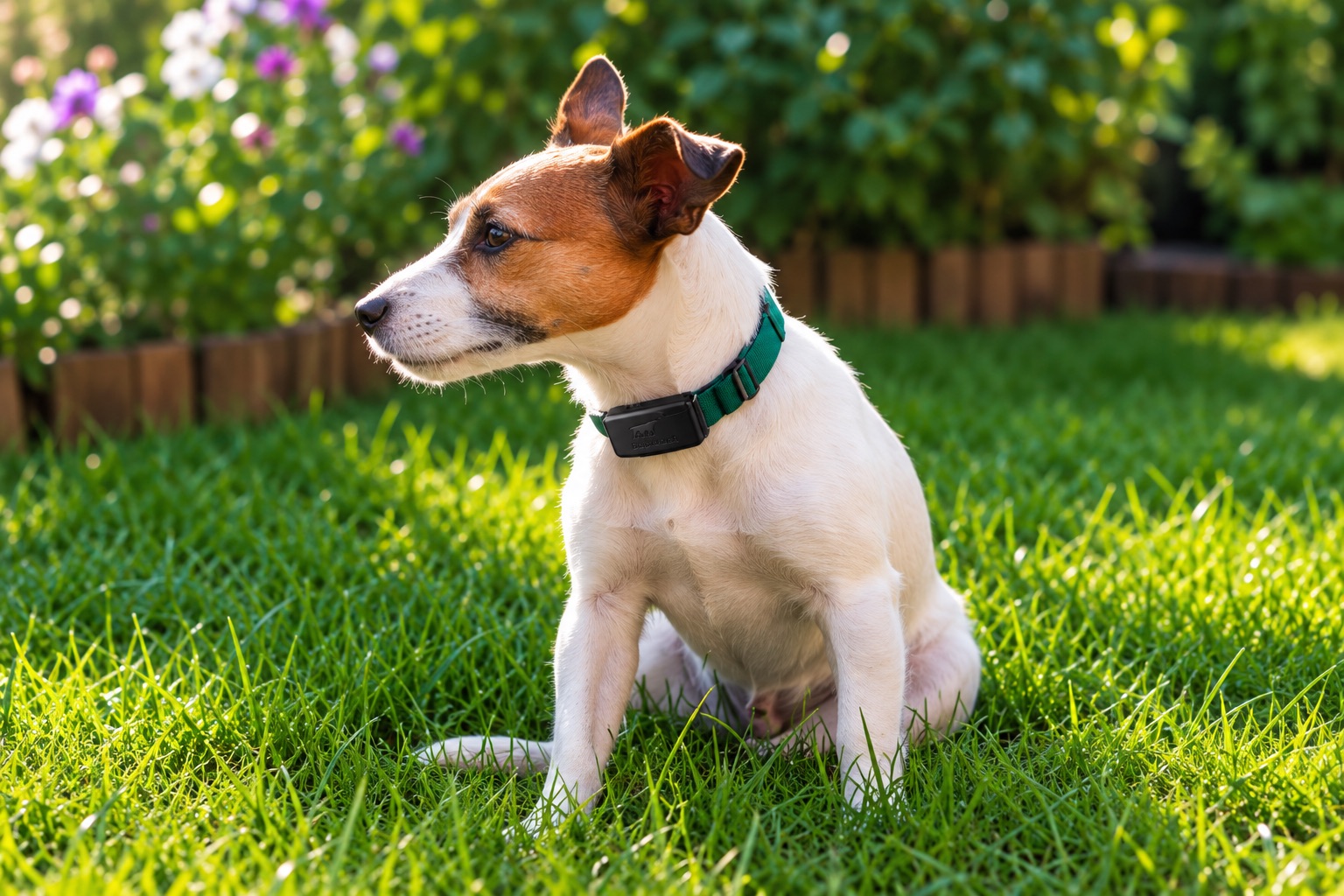
Do the math on a 40-foot yard
The GPS makers know this, which is why they publish minimum yard sizes. SpotOn recommends properties of at least a third of an acre for its newest model, with at least 80 feet of usable width at the narrowest point. It also recommends keeping GPS boundaries at least 15 feet from roads and other hazards to allow for potential GPS shifts. That rules out many smaller suburban lots right away.
Halo supports smaller virtual fences, starting at 30 by 30 feet. However, Halo’s own installation guidelines recommend maintaining at least 20 feet between the virtual boundary and buildings, and maintaining at least 15 feet between the boundary and public roads.
For homeowners with a backyard that’s only 40 feet deep, those distances matter. Every foot reserved for boundary setbacks or warning zones reduces the space available for a dog to run and play.
A professionally installed DogWatch Hidden Fence offers a different approach. Rather than relying on continuously calculated GPS coordinates, its boundary follows a physical wire installed around your property. Your local DogWatch Dealer can customize the layout and signal field to accommodate your yard’s dimensions, landscaping, and your dog’s individual needs.
The result is a consistent, predictable boundary designed for your property – not one that depends on satellite positioning accuracy.
A buried wire doesn’t drift
A DogWatch Hidden Fence works on a completely different principle. There is no estimate and no satellite. A wire is buried along the exact boundary your Dealer walks with you, and the collar responds to the signal radiating from that wire. The boundary follows the physical path of the buried wire, today and five years from now. Rain, snow, tree cover, a tall hedge, the aluminum siding on your garage, a cloudy sky: none of it moves the boundary, because the boundary is a physical object in the ground rather than a calculation.
The signal field is adjusted during installation to establish a consistent warning and correction zone. This means that the warning zone your dog learns in week one is the same warning zone it meets in year three.
DogWatch adds another layer of protection with its patented SafeLink® Digital FM technology, which helps protect against unintended corrections caused by stray radio signals. Precision isn’t a feature DogWatch had to engineer around a weakness. It is the nature of the system.
Why that matters for your dog
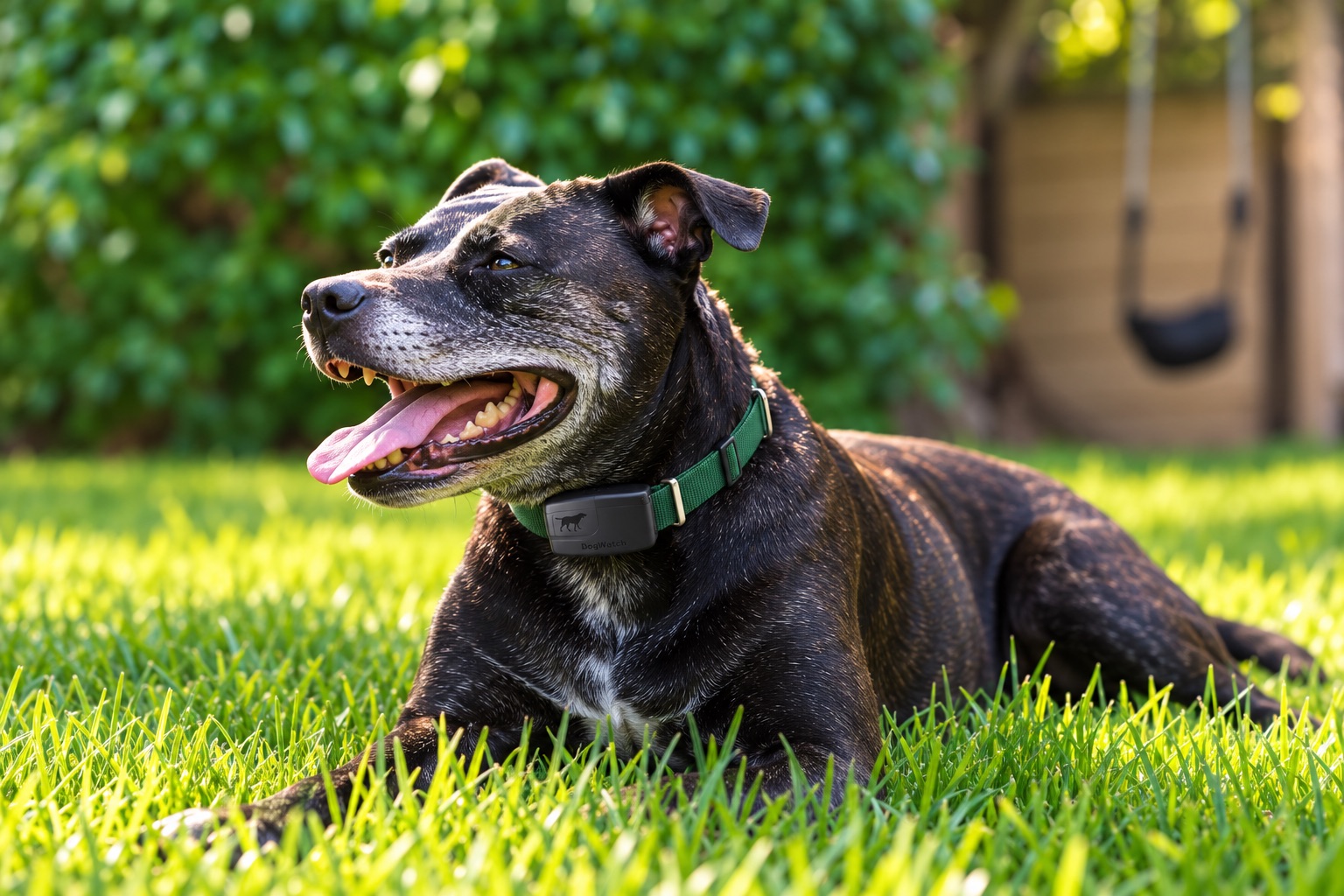
A fixed line is what makes training work. Your DogWatch Dealer walks the boundary with you and your dog, flags it, and teaches the dog where the warning tone begins and where safety is. Because the line never moves, the dog gets the same answer every single time it approaches the edge, and that repetition is how a dog goes from relying on the collar to simply knowing the yard. With consistent training and a clearly defined boundary, dogs can learn to recognize and respect their designated play area. Your local DogWatch Dealer provides personalized, hands-on guidance to help reinforce that training.
A fixed boundary also gives your Dealer the flexibility to make the most of your available yard space. The wire can be installed along property lines, around gardens, near sidewalks, or configured to create designated off-limits areas around pools and play spaces. Your Dealer adjusts the signal field to establish an appropriate containment area for your dog and your property.
That flexibility can be especially valuable for smaller pets. Halo’s system requires a dog of at least 10 pounds; a DogWatch collar can be fitted and tuned for the smallest terrier, toy breed, and even cats, too.
The right tool for the yard you actually have
GPS collars are a real innovation for the right property. If you have ten open acres, a hunting camp or a dog that travels with you, a few feet of drift is a fair trade for a fence you can carry in your pocket, and DogWatch provides the SkyShepherd GPS Dog Fence for exactly those dog owners.
But many dog owners don’t live on ten acres. They live on lots where the back fence line is close enough to hit with a tennis ball, and where “accurate to within a few feet” is simply not accurate enough. For that yard, the better answer has been in the ground for 35 years: a boundary that is exactly where you put it, every day, with no required subscription, a collar battery life of up to 2 years, and a lifetime limited equipment warranty.
If your yard is small, ask a local DogWatch Dealer to walk it with you. They’ll tell you where the wire should go, and that line will still be right there next spring, and for many years to come.
By DogWatch Team, August 6, 2026

Some dogs are perfectly content to lounge in the yard, soaking up the sun. Others treat your property line like a puzzle to be solved. If you’ve ever gotten “the call” — a neighbor spotting your dog three blocks away, again — you know the special anxiety of living with a canine escape artist.
Meet the Escape Artist
Escape artists come in all breeds and sizes, but they share a common trait: determination. These are the dogs who:
- Dig under fence lines like furry excavators, often in the same spot you just filled in
- Climb or jump over fences you were sure were tall enough
- Bolt through open gates and doors the moment someone’s hands are full of groceries
- Squeeze through gaps you didn’t even know existed
By Jaclyn Mosher, January 2, 2025

New Year’s Resolutions aren’t just for people – dogs can join in, too! Here are five resolutions for dogs, and how DogWatch products can help you and your pup achieve these goals in 2025. Read post »
By Jaclyn Mosher, May 16, 2023

When you picture Siberian Huskies, chances are you picture them in motion. Whether they are pulling a sled, running laps at the dog park or chasing squirrels, Huskies are among the most energetic and independent of all dog breeds. They are also well known “escape artists,” and can often be found digging under or leaping over fences.
Because of this reputation, pet parents often ask us: “Can a hidden fence really work for my Siberian Husky?”
Yes, it can! For over 30 years, DogWatch Dealers have been training Siberian Huskies, Husky mixes, Alaskan Malamutes and more to stay in their yards with our hidden fences. We reached out to our DogWatch Dealers and customers to learn more about the process of training Huskies, adjusting collars to work with their thick coats, and how adding an underground electronic fence to their property helped their smart and athletic pups enjoy their freedom! Read post »
By Jaclyn Mosher, July 30, 2019

Did you know that more than 10 million pets are lost each year in the United States, and one out of three pets will be lost during its lifetime? To bring attention to this issue, July has been designated Lost Pet Prevention Month, with the goals of increasing resources for preventing lost pets and relocating lost pets with their owners. July was chosen because July 5th is typically the busiest day for shelter intakes in the United States. The increase is shelter admissions on July 5th is attributed to dogs escaping their homes or running from their owners due to fear of 4th of July fireworks.
At DogWatch®, it’s our mission to keep pets safe. We are pet owners ourselves, and can understand the heartache that pet owners must feel when their pet is lost. We are dedicated to creating products than can help reduce the number of lost pets and give pet parents peace of mind that their dogs (and cats) will not be one of those 10 million lost each year. Read post »
By Jaclyn Mosher, May 24, 2019

This week, DogWatch Dealers Kathy and David Downey of DogWatch by Laughing Labrador donated 12 SideWalker® Leash Trainers to a unique public school therapy dog program in Brighton, Michigan to help improve the dogs’ leash walking behavior. The Downeys and DogWatch by Laughing Labrador installer Daniel Perez also hosted a hands-on training session with the therapy dogs and their handlers. Read post »
By Jaclyn Mosher, April 10, 2019

One of the questions DogWatch Dealers are frequently asked is “Can my dog get out of the hidden fence containment area?” The answer is that if the initial training was done properly, this will rarely happen. If it does happen, it is usually for one of the following reasons. The first reason accounts for approximately 90% of all incidents. Read post »
By Jaclyn Mosher, May 2, 2018

You love your dog. You love your garden. But dogs and gardens can be a difficult combination. Are you looking for a way to protect your carefully cultivated flowers, trees, bushes and veggies from your dog’s rowdy ways? Consider one of these products from DogWatch! Read post »
By Jaclyn Mosher, March 12, 2018
Did you know that DogWatch works for cats, too! Check out this great video from a very happy DogWatch cat customer!
Boo is a 1 year-old deaf male cat from Dallas, TX who loves to play in his backyard. Keeping him in the backyard, however, was a problem. Despite his family’s best efforts to keep him contained, Boo frequently climbed over fences and in trees to explore his neighborhood. This behavior is especially risky for Boo, as he is unable to hear the sounds of cars, wildlife or other potential dangers.
Boo’s family was in need a solution to keep him safe while still giving him the outside access he craved. So they called their local DogWatch Dealer, DFW DogWatch, to learn more about hidden fences for cats. “After long hard deliberation,” Boo’s mom wrote on YouTube, “we decided to install a hidden/radio fence with a correction collar to keep our cat Boo in the yard.” Read post »
By Jaclyn Mosher, December 8, 2017

Hidden fencing (a.k.a. electric dog fencing, invisible fencing, or underground fencing) has been in existence for a long time but has recently become more popular due to the ever increasing fence restrictions and our ability to trust more in technological advancements. There are some people, however, that are still leery due mostly to myths associated with this type of pet containment. We would like to address these myths and help educate the general public about the safety, humanity and convenience of hidden fences.
The six most popular myths associated with hidden fences are 1) the shock is dangerous and inhumane; 2) it doesn’t work on my breed; 3) my dog will never want to come outside again; 4) it will make my dog become aggressive; 5) it is too expensive and 6) store-bought systems work just as well as professionally-installed hidden fences. Read post »